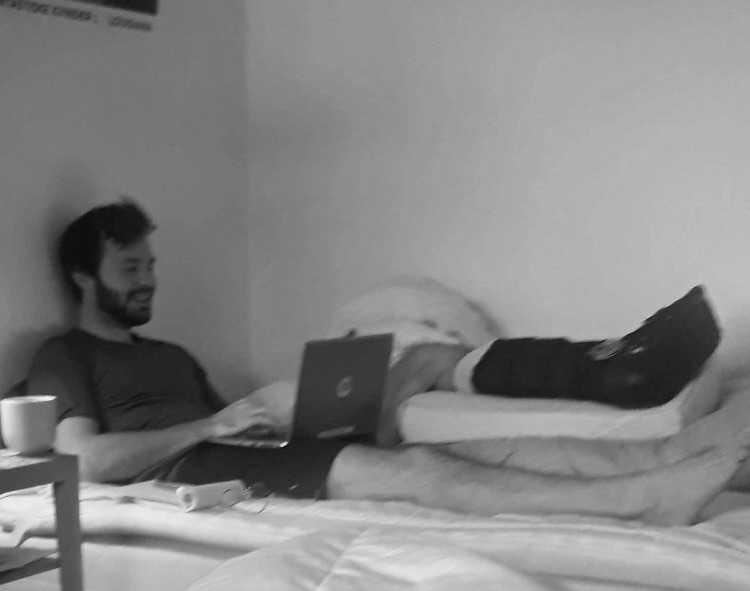
Facing long-term health issues — in my case, severe immobility — is a merciless, brutal reality. There are no quick fixes; there is no magic bullet. Every day is Groundhog Day. It is a radical loss of control, an unforgiving and painful realization that the universe and the laws of physics cannot be bent by sheer will; the recognition that your cries into the night sky are met with a deadening silence.
It requires a Spartan psyche to weather such an existential earthquake.
Guilt and shame visit and haunt me frequently: “Why did I do this?” “Why didn’t I do that?” “I’m a failure.” “If I had just done this or that…”
With time, however, I’ve learned to give myself grace. That means accepting that my emotions, thoughts and actions are valid responses to an incredibly challenging situation. That I’m okay — and that the reason I’m still stuck in a nightmarish reality isn’t because I’m broken, but because the odds were stacked against me from the beginning, because many things were ultimately out of my control.
Which, I guess, reflects life in general.
The lesson is thus to cultivate the ability to let go.
———
I will share something that I often return to in my mind. Six weeks after my achilles tendon surgery, I was supposed to step on my leg with full, or close to full, body weight. I couldn’t do it. Something had gone wrong with my leg in the prior weeks, halting the expected progress before week six.
I was at the hospital for a checkup at week six and for further physiotherapy guidance. The woman seeing me was a bit shocked by my lack of progress. I was able to step with 10–15 kilos instead of 75. I wasn’t physically comfortable doing more, as I’d already had issues the weeks before and wasn’t meeting even the smaller expected milestones.
The whole situation — realizing I was underperforming — spiked my anxiety about the future. I wasn’t actually afraid of using my leg; I just felt a clear signal from my body telling me not to overdo it.
What she then said, I believe, changed the course of my recovery:
“If you don’t step on your leg, you will not be able to walk.”
This spiked my anxiety even further and made me deeply uncomfortable. While objectively true, she didn’t meet me where I was, neither physically nor mentally, with that message.
What did I do when I got home? For a whole hour, on and off, I pressured myself to stand on the leg with a lot of weight, stretching the achilles tendon simultaneously. Her words lingered in my mind. I felt my future was at risk. Inadvertently, in trying to prevent the worst-case scenario, I helped usher it in.
Not long after I lay down to rest, I began feeling extremely intense pain, which led to complete immobilization of the leg and ankle for three whole days. The slightest ankle movement would flare up the overwhelming pain these days, and made my achilles tendon very sensitive onwards. This made a bad situation many times worse.
I wish she had communicated differently, and I wish I hadn’t panicked. Yet, being realistic, I understand today why I did, which helps me give myself that much needed grace.