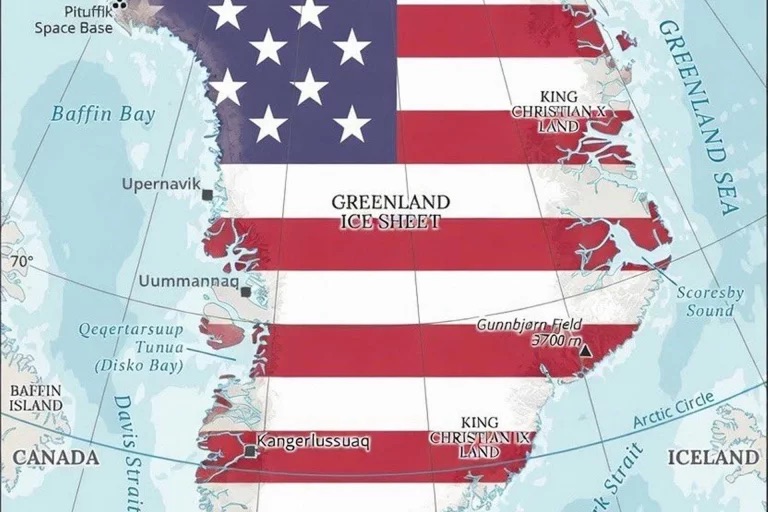
I’ve been listening to Danish politicians and political commentators lately, and my sense is that some of them are naive when it comes to the aspiring king, Donald Trump. They are analysing the Trump-Greenland issue using the wrong framework.
When asked whether Trump would use military force to take over Greenland, they say no, because it would not be rational. And I agree: it would not be rational for several reasons. Not least because the United States already has the right, under existing agreements, to install as much military infrastructure in Greenland as it wants for security reasons. It can also invest in mineral extraction. Another reason is NATO: a military intervention would seriously risk destroying the alliance. All in all, a military move would be costly and unnecessary.
However, Trump is not your run-of-the-mill rational actor – if he is one at all. I believe he cares only about himself and his family. He cares about power, status, and enriching himself and those closest to him. Because of this, Greenland is primarily a vanity, money, and machismo project. That is why Trump, I believe, will keep insisting on Greenland despite the fact that it is irrational – and why he may even be willing to use military force.
Greenland is not about American interests; it is about Trump’s interests.
It appears that Nicolás Maduro, after significant pressure, was in fact willing to acquiesce and make a deal with Trump. Yet Trump still went ahead and abducted him. That speaks volumes about Trump’s priorities and interests. Consider the following:
“Venezuelan President Nicolás Maduro has said he is open to negotiating with Washington to combat drug trafficking in the first sign that sustained U.S. pressure is taking its toll on the embattled South American leader.
…
‘If they want oil, Venezuela is ready for U.S. investment, like with Chevron, whenever they want it, wherever they want it and however they want it,’ he said.” (1)
Would Trump accept any deal Denmark might be ready to make? I am doubtful, though I certainly hope so. Perhaps all of this is overblown – by me and by many others. And of course, it is important to acknowledge that Greenland and Venezuela are very different cases. But how much does that matter if we conclude that Trump is not a rational actor?
Here is an excerpt from an article that lends support to the ideas above:
“The American incursion into Venezuela has caused a lot of people to say the U.S. is going back to the age of great power spheres of influence, where big countries threw their weight around and divvied up the world. But two months ago, you published a scholarly paper saying this might not be the perfect comparison. How do you describe this new American dynamic you call “neo-royalism”?
Goddard: The idea of great power competition and spheres of influence, the traditional way of understanding that era, actually doesn’t make sense of what’s happening now. We understand there’s all this stuff about the “Donroe Doctrine” and this Western hemispheric stance. But why it doesn’t make sense is that a lot of the moves that you’re actually seeing the Trump administration make aren’t necessary. They’re costly, and they undermine United States security.
Let me take the more recent example of Greenland. The United States already has a sphere of influence in Greenland. It can have any base it wants. Denmark has promised more influence on what is going on there. And what we argue is this has less to do with increasing spheres of influence or competing with great powers, and more to do with a Trump administration and a small clique of insiders who see themselves as exceptional and are basically demonstrating their dominance over subordinate territories. And if you understand that this is really designed to make a select group powerful, rather than the United States as a whole, it makes a lot more sense.
……
Goddard: No. There isn’t such a thing as national interest. That’s in some ways the most straightforward answer. And I think, too, that this is also different than, say, the autocracy-versus-democracy framework that a lot of people have been running with. In the 19th century, even if we’re talking about big names like Bismarck, we’re still talking about a national state that was interested in mobilization. It built bureaucracies, standing professional militaries,professional diplomatic corps. So there was all of this infrastructure in the state in order to accomplish this mobilization, both at home and abroad. And what we’re seeing here is not only the lack of a national interest, but a move from mobilization to the processes of extraction. It doesn’t really matter if you’re doing something to harness the power of the state. What matters is if you’re finding those resources to feed those clique interests.
……
These are more a group of actors who see a moment to create oligopolistic power. And so you’re seeing the tech companies, many of them, at the center of this. And one of the things that Stacie and I are very concerned about is the spillover of those economic actors willing to legitimize and play in this domain. These are actors who are acclimating themselves to this order and this way of business. Right now, this order is not yet consolidated, but the more these economic actors widen, the harder it will be to reverse.”(2)
1: https://www.nbcnews.com/news/amp/rcna251882
2: https://www.politico.com/news/magazine/2026/01/07/venezuela-royalism-donald-trump-00713276